
Substack In Ink
When “going viral” meant 3,000 crooked copies

Printing press time.
Before this, words travelled on skin, stone, metal, or in the memory of one exhausted monk. Suddenly one bad decision with a wooden block could haunt an entire continent.
You carved letters into a block of wood, inked it, pressed it on paper.
Over and over.
Same text. Same mistake. Thousands of times.
Congratulations. You just invented copy paste.
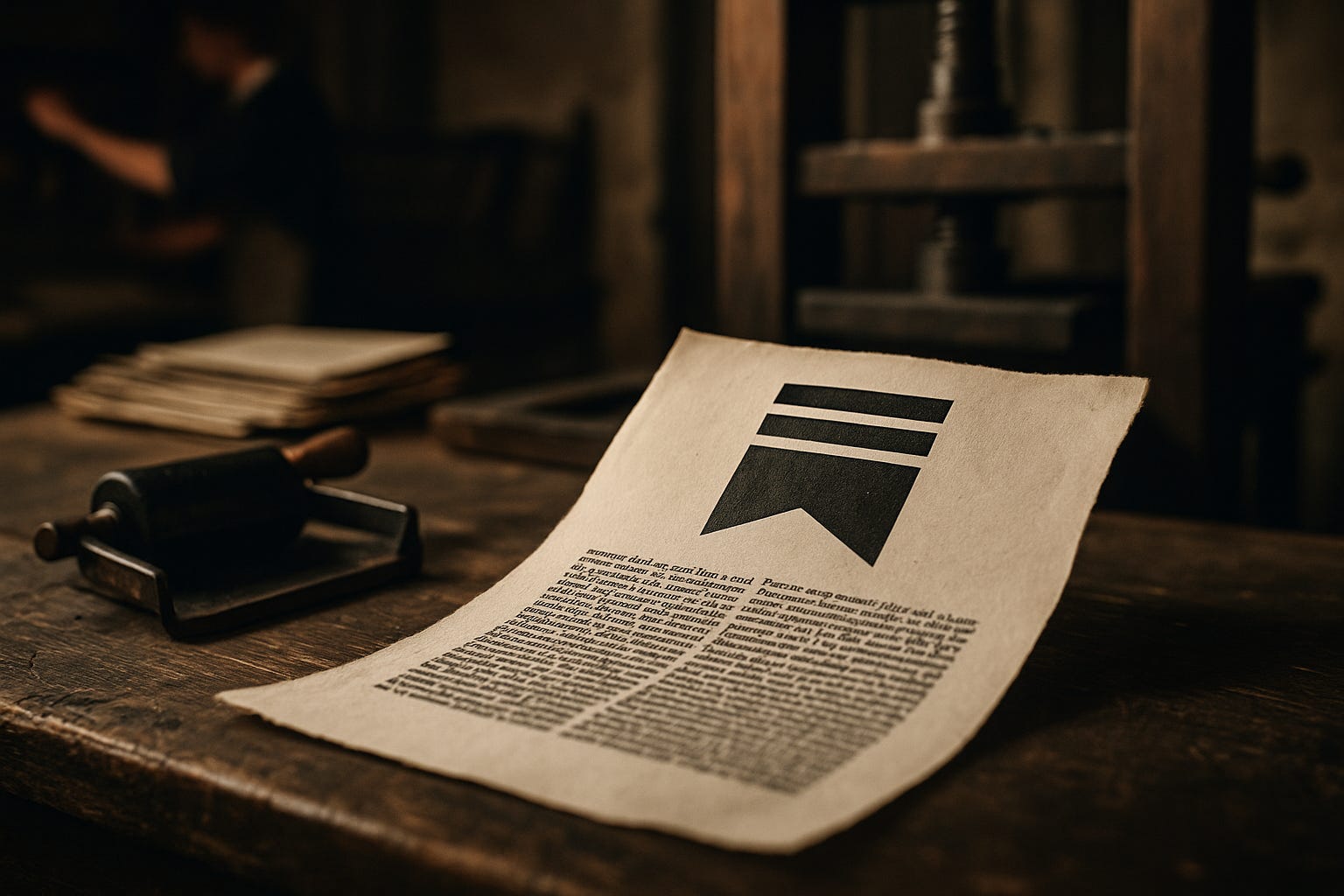
If Substack existed in that era, your newsletter would be a pamphlet. Thin, cheap, and everywhere. The logo would sit at the top as a rough black woodcut. Three bars, one little flag, all slightly wonky because the carver sneezed at the wrong moment and nobody wanted to start again.
You would not hit “send.”
You would hit “print” and then pray the ink did not run.
Communication got feral here.
1. Scarcity died. Attention began to bleed.
For the first time, a single mind could shout at thousands of strangers who would never meet them.
You write one text about taxes.
You print three hundred copies.
Someone copies your copy, prints three hundred more.
By the time you walk across town, your thoughts have more bodies than you do.
Feels familiar.
The bottleneck stopped being “can I publish” and became “can anyone hear me over this pile of other pamphlets about slightly more exciting sins.”
Gutenberg invented the printing press.
Everyone else invented spam.
2. Typos became historical events.
When a scribe miscopied a word, maybe ten people ever saw it. When a printer mis-set a letter, the entire run got blessed with the same weird glitch.
There was a real Bible edition where “thou shalt not commit adultery” lost one “not.”
Imagine explaining that patch note to your boss.
Early printers tried to proof. They really did. But deadlines, money, and human frailty existed back then too. Sometimes the mistake was cheaper than another run.
The result: errors became permanent features of culture. Scholars now hunt them like fossils.
You think your newsletter typo is bad. At least you can edit it quietly before anyone screenshots you.
3. The feed turned physical.
Walk through a city and the timeline lived in your shoes.
Posters pasted on walls.
Sheets nailed to doors.
Bundles of pamphlets dropped on tavern tables.
Every surface a notification.
Inside the tavern, people waved handbills at each other, shouting arguments line by line. Outside, kids used yesterday’s outrage to wrap fish.
The algorithm was weather.
If it rained, the news literally dissolved.
Substack in that world would be a stack of papers at the edge of the bar with a black little logo at the top and a headline that tried to punch harder than the one next to it.
“On The Corruption Of The Guild.”
“On The Moral Decay Of The Youth.”
“On Why You Are All Wrong About Grain.”
We have not changed much.
The woodcut style itself tells you a lot about how those people talked.
The lines are bold because the blocks could not handle tiny detail.
Curves are awkward.
Faces look a bit haunted.
You do not get nuance in a woodcut.
You get impact.
You want subtlety, you go to a painting.
You want to start a riot, you go to print.
So printers leaned in.
Big images.
Big fonts.
Saints and demons fighting in a space the size of your hand.
The idea was simple. If someone sees this from across the street, they should immediately feel something. That is all.
Your modern headline is just a digital version of the devil in the corner of that cheap print.
Now picture the logo.
Horizontal sheet of roughly cut paper. The fibers show. At the top, the Substack mark is carved as a chunky black woodcut. The three bars look like planks. The flag is a little too sharp, almost like a spear point.
Ink has bled slightly at the edges.
You can see where the block pressed harder on one side.
Below it, dense rows of text. First letters darker, last lines fading as the printer ran low on ink but decided to push one more pull through because paper is expensive and perfection is for rich people.
A few sheets are stacked on a bench.
One is nailed to a door.
One is already on the floor, stepped on, half torn.
Same message.
Three completely different fates.
This era is the moment writing stopped being rare and started being noisy.
Before print, if you wrote something, people assumed you had a good reason. You had to fight monks, materials, time.
After print, you could write because you were bored and wanted attention. A whole new category of human appeared: the person who manufactures outrage for a living.
We call them “content creators” now.
Printing made literacy worth it. Suddenly the ability to read changed your access to power, not just your access to prayers. At the same time, it made reading exhausting, because there were ten times more things to read, and most of them were trash.
Sound like your inbox.
So what is the squeeze here.
You and I have a printing press that would look like sorcery to those people. One click, thousands of perfect copies, no ink under your fingernails.
The temptation is to behave like the worst version of a pamphleteer.
Shout. Repeat. Stack posts until the feed buckles.
But the deep lesson from the woodcut age is this:
Once everyone can print, the only durable filter is care.
Care in what you say.
Care in how you carve it.
Care in how many times you are willing to ink the same block.
So before you send your next piece into the infinite, maybe ask their old question in your own language:
If this page were a cheap sheet nailed to a tavern door, smudged with grease and beer
would anyone still stop, squint at your little logo, and think, “Alright, fine, tell me what you see.”
Josh, this is a thoughtful essay. The comparison of the value of the printed word then and now, namely the quality viewed with responsibility is important 🫡