
Substack On Dial-Up
When every page load sounded like a dying robot screaming

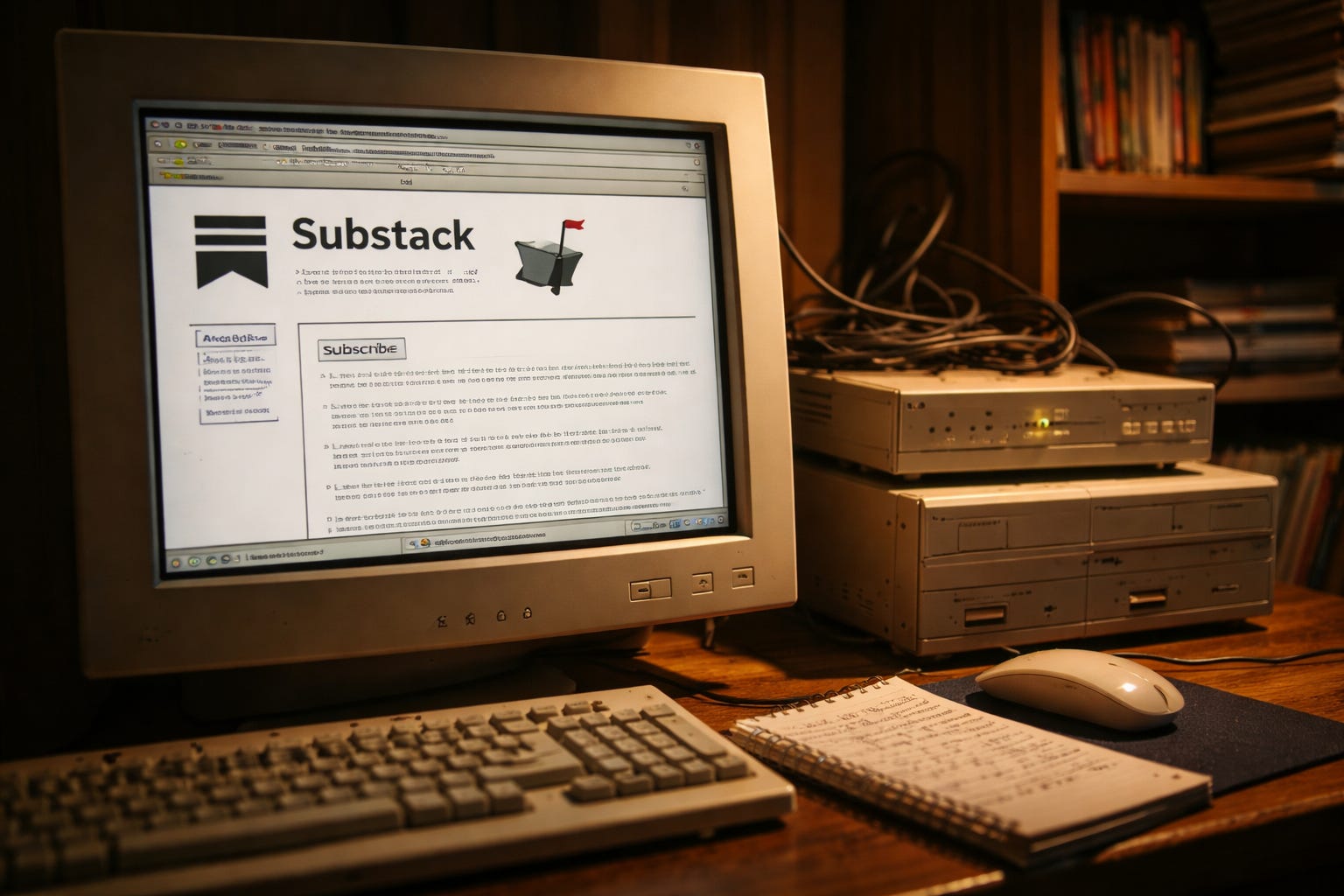
First there was neon.
Then there was this.
A beige box.
A fat monitor.
A modem that screamed at the wall like it was being exorcised.
Welcome to Web 1.0.
The internet before it got pretty, fast, and smug.
If Substack lived here, your newsletter would be:
a clunky HTML page
a mailing list with an address like
substack-newsletter-004@lists.coolmail.netand a “Subscribe” button that only worked on alternate Tuesdays.
The logo would be a tiny .gif in the corner, 64 by 64 pixels, sitting next to a “Best viewed in Netscape” badge.
You would not fight an algorithm.
You would fight your own connection.
The first big thing about this era.
1. Every click was a decision.
You did not casually open thirty tabs.
You opened one.
You waited.
You watched three lines of text appear, then two broken images, then a spinning icon that never stopped.
If the page looked like a crime scene of fonts and colors, you closed it. Not because you were picky. Because this thing was eating your phone line and your parents wanted to call someone.
Attention was expensive again.
Not the “I’m busy” kind.
The literal “this costs money per minute” kind.
Substack back then would have to earn every load.
No autoplay.
No bloat.
Just straight HTML and the hope nobody picked up the landline.
2. Everyone was screaming and whispering at the same time.
Websites looked like personality explosions.
Blinking text.
Flames.
Visitor counters proudly showing “000017”.
Every page was a flyer stapled to an infinite noticeboard.
Your homepage was your entire brand and your therapy session.
You could feel the newness of it.
“This is my corner of the world” translated to “here is my soul, tiled as a background.”
Then email came in swinging.
Chain letters.
Forwarded jokes.
Those “send this to 10 friends or your crush will marry a dentist” curses.
Buried between them, actual letters. Actual lists. Early proto newsletters that did what we still do now, just with worse fonts and more risk of getting sent a virus in a Word attachment.
It was messy and weird and oddly sincere.
3. There was no feed. Only doors.
No timelines yet.
No endless scroll.
You went to places.
Type a URL.
Follow a link from someone’s “links I like” page.
Click into a ring of sites tied together by a little banner that said “you are visitor 431 to the CyberPoets Ring.”
Discoverability was literally wandering.
Substack back then would be a cluster of small sites pointing at each other.
“No algorithm will bring you here. A friend will.”
The good part: fewer rage mobs.
The bad part: if you did not know anyone, you were invisible.
Today the feed finds you.
Back then you felt like you had to push your way through bushes of under construction gifs with a digital machete.
Now picture the logo.
Horizontal frame.
Dim bedroom lit by a CRT monitor. On the screen: a clunky early-web page. Grey background. Table layout. Blue hyperlinks. At the top, a tiny black Substack icon made of three pixel bars and one jagged little flag. Right next to it, maybe a spinning mailbox gif going at war with your migraine.
Beside the monitor sits a tower PC, beige and humming. On top of it, a tangle of cables. On the desk, a spiral notebook full of scribbled URLs because bookmarks feel too fragile.
Off to the side, the modem blinks like a small, nervous spaceship.
No one else is awake.
You are alone with the slow light.
Somewhere under that ugly header is a piece of writing that somehow hits you harder than all the glossy TV from earlier.
What I love about this stupid, beautiful era is how obvious the friction was.
Lag. Disconnects. 404s.
You could feel the struggle in your body.
Now the friction went underground. The pages load. The scroll is smooth. The cost is buried in your nervous system instead of your phone bill.
Web 1.0 was clumsy but honest.
It did not pretend it was effortless.
You also see the origin story of all your current compulsions.
The urge to refresh.
The joy of an unexpected email from a stranger.
The habit of turning late-night loneliness into HTML.
We still run the same protocols. We just wrapped them in better design and little frameworks to keep ourselves from drowning.
So here is the squeeze this era throws at you:
If your readers had to wait thirty seconds and listen to a modem scream before each of your posts loaded
would they still think you’re worth the noise?