

The Crowd Inside Your Skull
Evolution, game theory, and why the self behaves like a government formed in the middle of the night

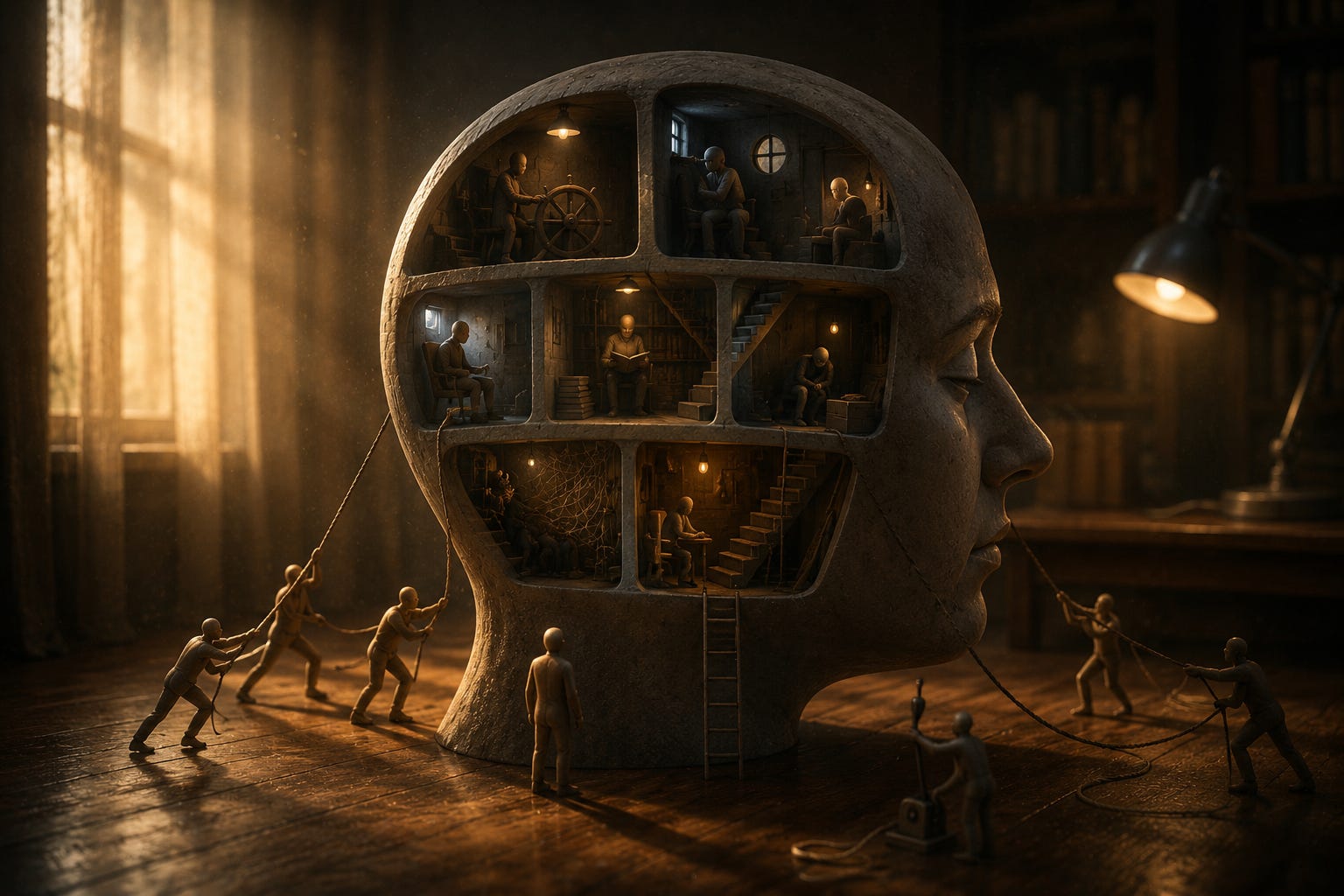
I opened the fridge at midnight and found three people standing there.
One wanted cheese.
One wanted to become healthier, calmer, and suspiciously attractive by Tuesday.
The third had forgotten why we opened the fridge and was staring at a jar of mustard like it contained classified information.
All three were me.
This seems inefficient.
We talk about the self as though it is one clean thing.
A captain.
A soul.
A little manager sitting behind the eyes, moving levers and approving snacks.
It would be comforting.
It would also explain absolutely nothing.
The person who sets the alarm is not the person who hears it.
The person who buys vegetables is not always the person who discovers them six days later, wet and ashamed, beneath the cheese.
The person who says, “I don’t care what anyone thinks,” often spends the next hour editing a message so it appears they do not care what anyone thinks.
The self is not a king.
It is a meeting that never ends, held in a room with bad lighting.
Neuroscience does not reveal a tiny chief executive hiding in the skull.
There are systems.
Networks.
Old machinery.
Newer machinery sitting on top of old machinery and taking credit for the building.
Some systems react fast.
Some calculate slowly.
Some notice hunger.
Some notice status.
Some remember your father’s tone from 1994 and apply it to an email from a dentist.
No single part is “you” in the simple way we like to imagine.
The crowd produces you.
Like a city produces traffic.
Nobody wakes up and personally invents Tuesday congestion.
Millions of small decisions cooperate badly until a recognizable disaster appears.
Evolution built the crowd gradually.
It did not sit down with graph paper and design a balanced person.
It kept whatever survived long enough to reproduce.
A fear that worked once stayed.
An appetite that found calories stayed.
A tendency to copy the tribe stayed.
A suspicious reaction to unfamiliar footsteps stayed.
Then civilisation arrived with supermarkets, tax portals, dating apps, and meetings about meetings.
The old systems remained.
They now hunt promotions, pastries, and tiny red notification circles.
A brain shaped partly for uncertain food can stand in front of forty-seven varieties of cereal and experience a spiritual collapse.
This is not necessarily weakness.
It is ancient equipment in a brightly lit warehouse.
The hungry part of the brain does not care about your five-year plan.
It knows winter.
Even when winter is now an air-conditioned office and the nearest predator is called Darren from Accounts.
The social part does not care that strangers on the internet have no authority over your life.
It knows exile.
For most of human history, being thrown out of the group was not a brave personal-branding exercise.
It was a serious logistical problem involving cold, teeth, and no Wi-Fi.
So a bad comment still lands strangely deep.
The words are pixels.
The body hears branches snapping outside the firelight.
This is where game theory wanders into the skull.
Every part wants something.
Safety.
Pleasure.
Status.
Rest.
Novelty.
Belonging.
Control.
A dramatic exit from the conversation followed by immediate reassurance that everyone noticed.
These motives cooperate when they can.
They compete when they must.
The result is less like a machine and more like a coalition government.
The health minister wants sleep.
The entertainment minister has discovered a twelve-part documentary about a fraudulent mushroom company.
The finance minister wants restraint.
The inner raccoon has found an online sale.
Nobody has a majority.
Decisions pass through deals.
“I will eat the salad if there is bread.”
“I will answer the email after one video.”
“I will go to bed after checking one thing.”
“One thing” is the most corrupt politician in the building.
It has never left office.
The future self also sits at the table.
Poor bastard.
The present self treats him like unpaid staff.
Tomorrow will exercise.
Tomorrow will make the call.
Tomorrow will understand the instructions.
Tomorrow is expected to wake early, clear the sink, answer twelve messages, repair the economy, and remain emotionally available.
Meanwhile today is lying on the couch watching a man restore an axe.
This is temporal discounting.
A reward now often feels more valuable than a larger reward later.
The future is dim.
The biscuit is here.
The biscuit has excellent lobbying.
The strange thing is that we experience all this bargaining as a single voice.
After the vote, the winner writes the history.
You eat the cake, then explain that it would have gone stale.
You avoid the conversation, then decide the timing felt wrong.
You buy the thing, then announce that quality saves money in the long run.
The mind is a gifted press secretary.
It can turn panic into intuition.
Jealousy into standards.
Avoidance into patience.
A terrible decision into “something I needed to experience.”
Sometimes it is lying.
Sometimes it is protecting the coalition from collapse.
A person who saw every motive clearly, every second, might never get out of bed.
Too much transparency ruins institutions.
Possibly marriages too.
We need a little blur.
The brain gives us a story neat enough to carry.
“I decided.”
Two words.
Very tidy.
Behind them, forty departments threw chairs.
This does not mean choice is fake.
It means choice is crowded.
A parliament still produces laws, even if half the members are asleep and one appears to be taking instructions from a sandwich.
The final act is real.
The route there is just less noble than the minutes suggest.
I notice the crowd most clearly in small moments.
Standing in a shop with two nearly identical bottles.
One part wants the cheaper one.
One wants the nicer label.
One distrusts both because the font looks confident.
One remembers a review read three years ago by someone called WolfDad77.
Then the hand reaches.
Decision.
History rewritten.
“I preferred this one.”
Of course.
A clean story is placed over the crime scene.
The crowd also explains contradiction.
People often say contradiction is hypocrisy.
Sometimes it is.
Sometimes it is simply evidence that more than one honest motive survived the meeting.
I wanted freedom.
I wanted guarantees.
I wanted intimacy.
I wanted no one close enough to rearrange my cushions.
I wanted recognition.
I wanted to remain mysteriously undiscovered.
All sincere.
All impossible together.
We are not inconsistent because we are broken.
We are inconsistent because different systems measure success differently.
The part that wants adventure counts distance.
The part that wants safety counts locks.
The part that wants love counts closeness.
The part that remembers pain counts exits.
They can look at the same room and produce four weather reports.
This becomes obvious in relationships.
One person says, “Give me space.”
Inside, several departments panic.
One hears rejection.
One hears relief.
One wants to respect the request.
One starts composing a flawless message that proves it does not need to send a message.
The fingers hover.
Civil war with autocorrect.
Love is game theory with soft furniture.
Two nervous systems predict, offer, retreat, test, forgive, misread, and occasionally share dessert.
Each tries to stay safe without making the other person feel unsafe.
A complicated arrangement.
It is frankly impressive anyone gets through breakfast.
Trust changes the game.
Without trust, every action may contain a hidden cost.
Silence becomes punishment.
Kindness becomes strategy.
Distance becomes abandonment.
With trust, the same silence can become rest.
The same kindness becomes kindness.
Nothing mystical happened.
The expected payoff changed.
The nervous system stopped reading every spoon as a knife.
Status has its own loud department.
It pretends to be above all this.
Status enjoys pretending.
It compares.
Tracks.
Measures.
Not always money.
Attention.
Beauty.
Competence.
Who was invited.
Who was thanked.
Who laughed when you spoke.
Who laughed half a second too late, which is apparently enough to trigger an internal inquiry.
The status system is useful.
It helps us navigate groups.
It also turns a pleasant afternoon into an invisible leaderboard.
You can be eating cake beside the sea and suddenly feel behind because someone younger bought a kitchen island.
The kitchen island has won.
You did not know you were competing.
Neither did they.
The crowd entered a tournament while you were holding a fork.
The internet pours petrol on this.
We see the polished output of millions of coalitions.
The finished body.
The finished book.
The finished house.
The finished opinion.
We do not see the departments screaming in the basement.
So we compare their official photograph with our security footage.
Obviously we look unstable.
We are watching ourselves argue in real time.
They posted the press release.
Still, the crowd is not only chaos.
It creates intelligence.
Different systems notice different things.
Fear notices risk.
Curiosity notices openings.
Disgust notices contamination.
Desire notices value.
Sadness notices loss.
Play notices possibilities that seriousness walks past in sensible shoes.
A mind with only one motive would be clean.
It would also be stupid.
The crowd is expensive because flexibility is expensive.
You can freeze, flee, flirt, bargain, joke, attack, apologise, pretend not to understand, or suddenly become fascinated by a curtain.
That range kept humans alive.
It also makes family dinners longer than necessary.
The trickiest department is the narrator.
The voice that says “I.”
It arrives after much of the machinery has already moved, then explains what happened with the confidence of a tour guide who joined halfway through.
The narrator is not useless.
Stories coordinate the crowd.
A repeated story becomes policy.
“I am unreliable.”
“I always ruin things.”
“I work best under pressure.”
“I don’t need anyone.”
These sentences begin as descriptions.
Then departments start budgeting around them.
The unreliable person delays because delay fits the constitution.
The person who works best under pressure quietly creates pressure to preserve the myth.
The person who needs no one becomes remarkably skilled at selecting people who cannot be relied upon.
The story wins elections because it controls the map.
This is not a motivational speech.
The crowd hates motivational speeches.
Someone always steals the pastries and leaves before the final slide.
It is simply odd to notice that identity may be less like a statue and more like a treaty.
Treaties can hold for years.
They can also be rewritten after one bad winter.
Sometimes one department grows too powerful.
Fear takes emergency control.
Hunger starts running foreign policy.
Shame controls the newspapers.
Ambition abolishes weekends.
The whole country still calls itself by your name.
From outside, people see behaviour.
From inside, you hear doors slamming.
There is tenderness in knowing this.
Not an excuse.
Not innocence.
Just a better map of the mess.
A person can mean well and still hurt you.
A person can love you and still protect themselves at your expense.
A person can tell the truth in one room and lie in another because different coalitions came to power.
Humans are not always secretly evil.
Sometimes they are just badly governed mammals with passwords.
I return to the fridge.
The cheese remains.
The healthy minister has produced a statement.
The tired minister has resigned.
The mustard still looks important.
I stand there in the cold light, feeling the machinery negotiate.
Then I close the door.
Not because one version of me won.
Because all of them got distracted.
That may be consciousness at its most honest.
A temporary agreement between animals, memories, predictions, and a hand resting on the fridge handle.
The room goes dark.
The meeting continues.
It always does.
No king.
No final vote.
Just a crowd learning, very slowly, how to live under one name.