
The Elevator Button Doctrine
Floors don’t care. They still record you.

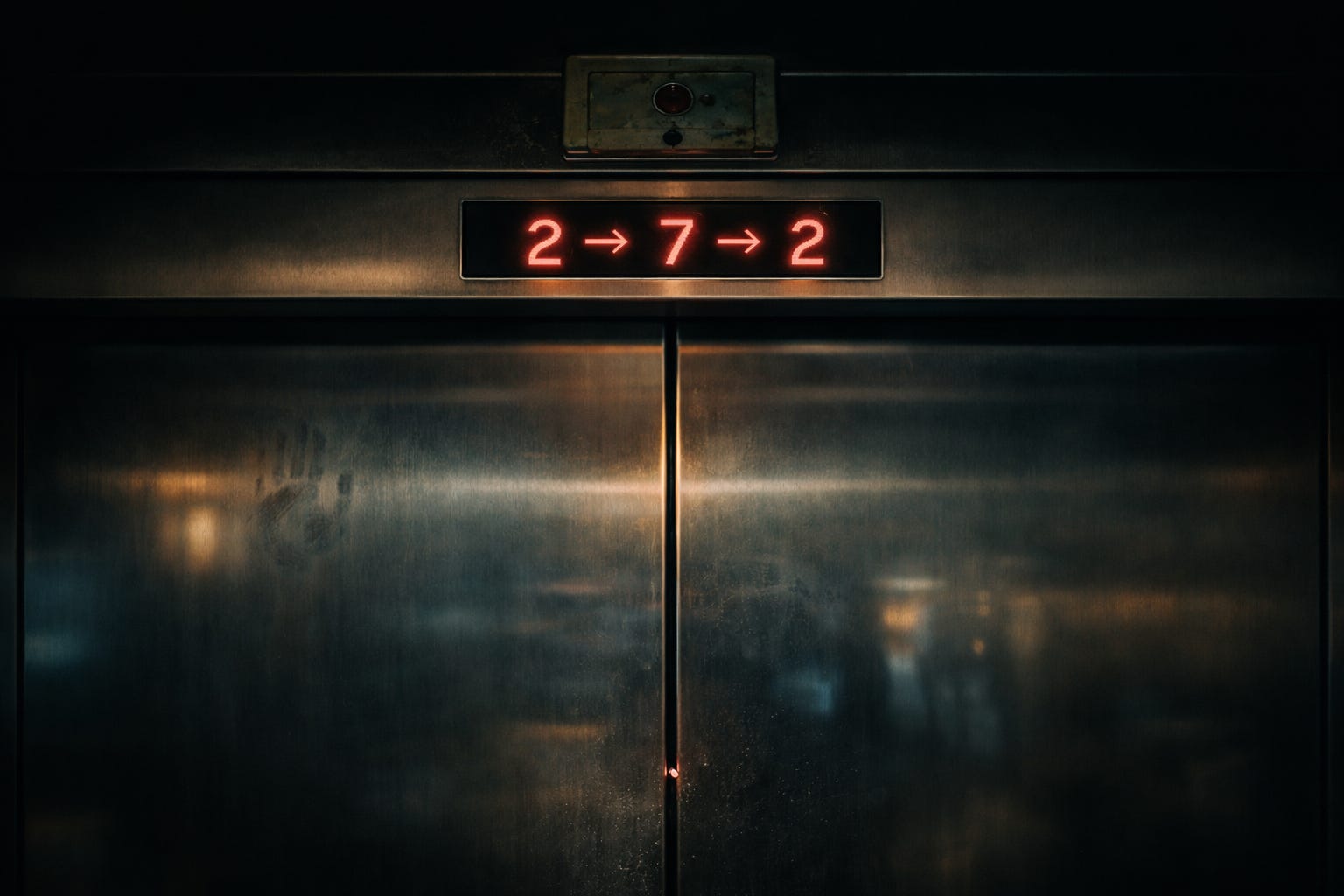
The hotel lobby smelled like citrus and carpet glue.
Like someone tried to clean fear with a lemon wipe.
Like it worked on the surface.
The elevator doors blinked open and shut.
Open. Shut.
A mouth practicing innocence.
Someone got reorganized in the corridor on Floor 7.
Three inches under the ribs.
The busy kind.
He dropped his keycard like a tiny white flag.
The manager said the cameras were “down for maintenance.”
Maintenance is what guilty systems call amnesia.
I wasn’t a detective.
I was a man with a stale coffee and a hatred of lies that wear uniforms.
So I talked to the elevator.
Elevators don’t remember faces.
They remember pressure.
Button 7 had a shine in the shape of a thumb that presses hard.
Not a gentle tap.
A demand.
The plastic around it wore micro-scratches like nervous laughter.
The kind you get when someone keeps hitting the same point,
waiting for the world to open faster.
The mirror inside the lift held fingerprints like secrets.
One smear was fresh.
One smear was old.
One smear smelled faintly of lemon and petrol.
There was a woman in the lobby with a suitcase that didn’t look lived-in.
New wheels. No scuffs.
A suitcase that had never been dragged through a bad choice.
She said she was visiting her cousin.
Her mouth said cousin.
Her eyes said exit.
A man in a suit stood by the fern pretending to scroll.
Screen dark.
Thumb moving anyway.
He said he’d been in his room all night.
Room service receipt in his hand like a shield.
Time stamped 22:19.
He kept showing it to people like a passport.
The body got folded at 22:17.
Receipts are loyal.
They just don’t care who they hurt.
I watched the elevator panel again.
Button 7.
Button 2.
Button 7.
Down. Up. Down.
A nervous loop.
Then I noticed the tiny thing nobody notices until it owns them.
The emergency stop cover had a hairline crack.
A fingernail had lifted it.
Not enough to break it.
Enough to say: I was here. I panicked. I touched the forbidden.
People don’t touch that cover unless something inside them is louder than manners.
I asked the manager for the elevator service log.
He sighed like a man trying to make numbers less real.
He printed it anyway.
22:12 call from lobby.
22:13 arrival.
22:14 door held open.
22:15 Floor 7 requested.
22:16 stop cover opened.
22:16 door held again.
22:18 Floor 2 requested.
The suit man’s receipt trembled once.
Not much.
Just enough to prove the paper had a pulse.
He said the lift sometimes does weird things.
He said guests play with buttons.
He said kids.
There were no kids in this hotel.
Only adults who still acted like them in private.
The woman with the suitcase looked at Button 7 like it had insulted her.
She said she didn’t go upstairs.
She said she arrived at 22:30.
Her boarding pass said 19:40.
Her taxi app said 21:57.
Her story was built from foam.
I checked her hands.
Dry to the wrist.
Only the fingertips had rain.
Dry to dry.
Car to door.
A person who had never stood outside long enough to be honest.
Then the elevator gave me the punchline.
A tiny crescent of red nail polish on the edge of the stop cover.
Not blood.
Polish.
A lipstick mistake on a machine that never kisses anyone.
The woman’s nails were nude.
Her ring finger was chipped.
The suit man’s assistant, the one who kept quiet like a trained animal,
had red nails.
Perfect, glossy, expensive red.
She stood behind him like a shadow that had learned payroll.
I didn’t say anything yet.
I let the room keep lying until it got tired.
Then I did the only thing that works with people who rehearse.
I pressed Button 7.
Nothing happened.
Of course not.
The police had locked it out.
But the panel lit up for half a second anyway.
A weak glow.
A reflex.
The assistant flinched like the light had spoken her name.
The suit man tried to smile it off.
He made a joke about elevators being moody.
Nobody laughed.
Not even the fern.
I told the officer the simplest version.
He didn’t like simple.
Simple makes paperwork personal.
“Floor 7 is a choice,” I said.
“Stop cover opened is a panic.
Back to Floor 2 is an escape.
The cameras are down because the truth was expensive.
The elevator still kept the bill.”
The officer stared at the log like it was a mirror he couldn’t punch.
The assistant cried first.
Not because she felt bad.
Because she was tired of holding the lid on the truth.
She said the suit man promised it would be clean.
She said the corridor was empty.
She said he only meant to scare him.
She said the knife moved like it had been waiting.
The suit man kept clutching his receipt.
Like paper could parent him back into innocence.
I watched the elevator doors close.
Open. Shut.
Open. Shut.
A mouth practicing nothing.
People always ask why I trust objects.
Because objects don’t want you to like them.
They just want to be accurate.
Buttons don’t do alibis.
They do pressure.
And pressure is the closest thing most people ever get to truth.
Pull line: Buttons don’t do alibis. They do pressure.