

The Phone Dies First
A practical communication plan for the day the internet gets weird, the signal gets drunk, and everyone suddenly becomes an expert in panic.

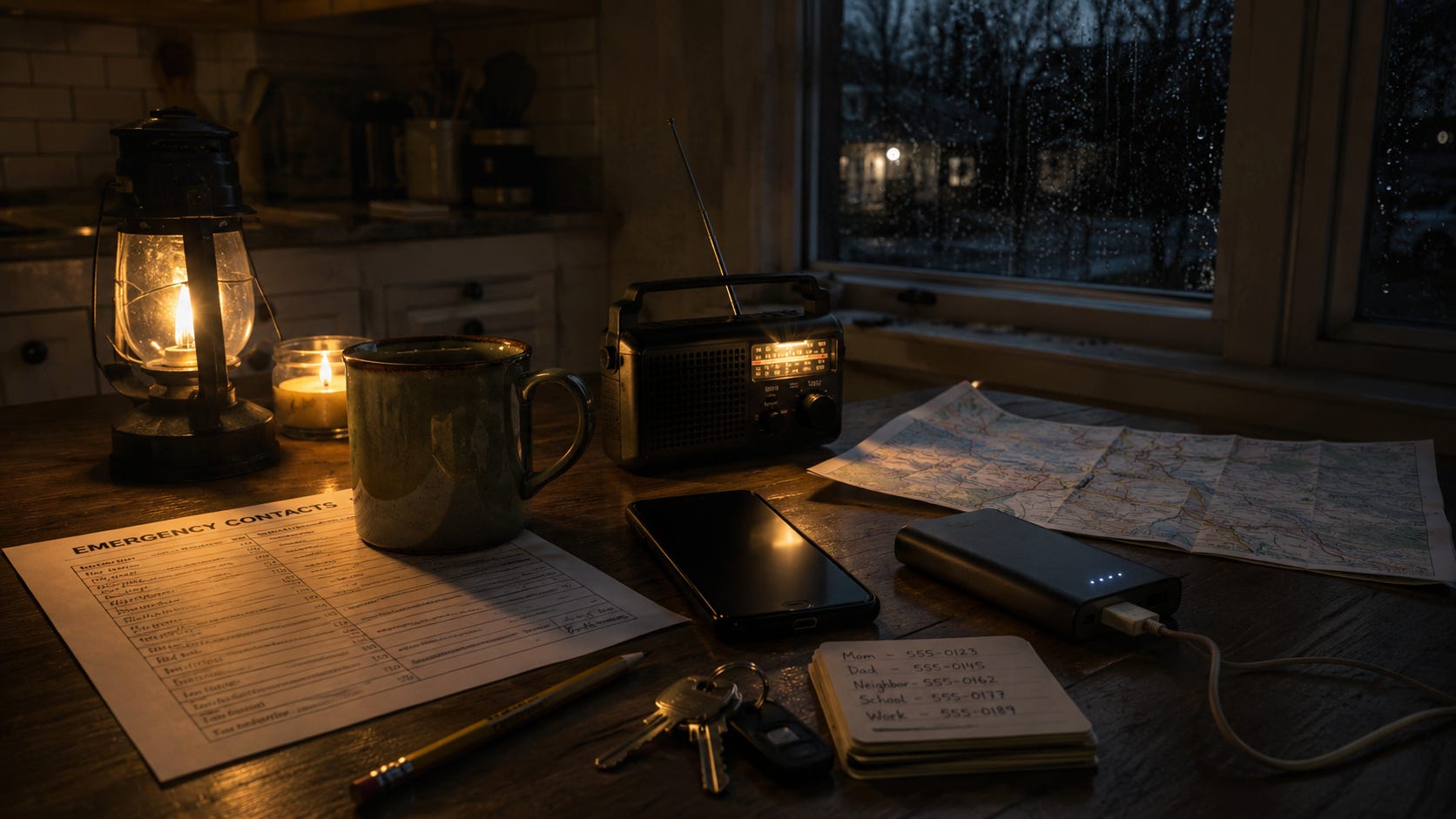
A dead phone on a kitchen table looks stupid.
Black glass.
No signal.
No map.
No contact list.
No group chat full of people saying “any updates?” like updates are hiding under the sofa with a digestive biscuit.
This is where collapse gets personal.
Not in the grand speeches.
Not in the headlines.
In the moment you cannot reach your kid, your partner, your old neighbour, your mum, your mate across town, or the one useful person who owns a van and still answers calls like it is 2007.
Preparation is not a bunker.
Sometimes it is a piece of paper on the fridge.
A boring piece of paper can become command structure when the shiny rectangles die.
Build the Fridge Sheet
Every household needs one printed emergency communication sheet.
Not saved in Notes.
Not buried in WhatsApp.
Printed.
Laminated if you are feeling fancy. Taped to the fridge if you are normal and slightly suspicious of your own memory.
Ready.gov recommends making a family emergency communication plan with household contacts, meeting places, and key information everyone can access during a crisis. The American Red Cross also provides emergency contact cards meant to be printed and carried by each household member.
Your Fridge Sheet should include:
Full names and phone numbers
Home address
Work and school addresses
Medical needs and medications
Out-of-area contact
Local emergency numbers
Utility shutoff locations
Two meeting places
One “we are safe” message template
One “need help now” message template
The out-of-area contact matters because local networks can choke while someone outside the affected area can still receive messages and relay information. It is not dramatic. It is just sensible. Like having spare toilet paper before the apocalypse remembers your digestive system exists.
Use Text First
In a crisis, voice calls are greedy.
They ask the network for too much.
Text is the quiet little rat that can sometimes sneak through the wall.
FEMA guidance notes that text messages may get through when calls do not because they use less bandwidth and can store, then send when capacity becomes available.
So your first move is not a phone call.
Your first move is a short text.
Use this exact format:
SAFE. Home. 4 people. Water for 2 days. No injuries. Next check 18:00.
Or:
HELP. Calle Mayor 14. 2 adults, 1 child. Injury. Need transport. Door blue.
No poetry.
No “OMG.”
No twelve-message emotional buffet.
The network is coughing blood. Be kind to it.
Set Check-In Windows
A family group chat becomes a panic machine when everyone messages every 4 minutes.
So set check-in windows now.
Morning.
Afternoon.
Night.
For example:
08:00
14:00
20:00
At each window, everyone sends one status message.
Location.
People.
Injuries.
Water.
Next move.
That is it.
Order is not the absence of fear. Order is fear sitting down and filling out the form.
Pick Two Meeting Places
You need two.
One near home.
One outside the neighbourhood.
The Red Cross contact card model includes emergency meeting places such as near home and out of the neighbourhood.
Choose places that are easy to describe.
Not “by that wall near the shop with the weird sign.”
That is how people vanish into administrative stupidity.
Use something plain:
Near home: front gate of the primary school.
Outside area: main entrance of the train station.
Backup: church steps, west side.
Add walking routes.
Add bike routes.
Add a rule:
If separated and no comms, wait 30 minutes at Meeting Place 1, then move to Meeting Place 2 only if staying becomes unsafe.
You are not trying to predict the universe.
You are giving scared people fewer decisions.
Make Contact Cards
Each person carries one.
Wallet.
School bag.
Coat pocket.
Phone case.
The Red Cross specifically advises printing a card for every household member, filling it in, and carrying it during an emergency.
Card contents:
Name:
Address:
Phone:
Emergency contact 1:
Emergency contact 2:
Out-of-area contact:
Medical conditions:
Medication:
Allergies:
Meeting place 1:
Meeting place 2:
For children, add:
Parent/guardian names:
School:
Approved pickup people:
Children do not need a lecture about systemic fragility.
They need a card, a meeting place, and one adult who does not turn into soup under pressure.
Keep a Small Radio
A phone gives you noise.
A radio can give you public information when the internet starts acting like a haunted cupboard.
Keep one battery or hand-crank radio in the house.
Store spare batteries.
Know your local emergency broadcast stations.
For mobile alerts, check that official emergency alerts are switched on. In the United States, Wireless Emergency Alerts deliver critical warnings to compatible wireless devices through participating providers, and the FCC describes them as geographically targeted emergency messages. Other countries have their own alert systems, so check your local civil protection guidance.
Do not rely on one channel.
Have layers.
Phone.
Text.
Radio.
Paper.
Neighbour.
That last one is ancient technology, but it has excellent battery life.
Create a Building Chain
If you live in a building, make a simple contact chain.
Not a dramatic militia thing.
Not “Defenders of Block B.”
Just humans who know who needs help.
Floor 1 checks Floor 2.
Floor 2 checks Floor 3.
Someone checks the elderly man with the shopping trolley.
Someone checks the single parent.
Someone knows who has insulin in the fridge.
Someone knows who has tools.
Someone knows who panics, which is also useful information.
Write it down.
People love saying “community” until community asks them to knock on a door before lunch.
The 15-Minute Drill
Once a month, do this.
Set a timer for 15 minutes.
Everyone puts phones on airplane mode.
Each person finds the Fridge Sheet.
Each person reads the meeting places.
Each person sends the status message template once, then deletes it.
One person checks the radio.
One person checks the power bank.
One person updates the contact card.
That is the drill.
No candles.
No drama.
No “we are ready for the end times” speech while holding a tin of beans like a philosopher.
Just practice.
The first time you do it, it will feel awkward.
Good.
Awkward now is cheap.
Awkward later is expensive.
The Minimum Kit
For communication collapse, keep:
Printed Fridge Sheet
Contact cards for everyone
Waterproof pouch
Permanent marker
Pencil and small notebook
Battery or crank radio
Spare batteries
Two power banks
Charging cables
Offline maps on phones
Paper map of local area
Whistle
List of neighbours and needs
Simple door note cards: SAFE, NEED HELP, EVACUATED
Door notes are underrated.
If you leave home, tape one inside a window or somewhere safe from public view if security allows:
EVACUATED. 12 May. 14:30. Going to Station Meeting Point. 4 people. No pets inside.
That one note can stop someone wasting 20 dangerous minutes looking for ghosts in your hallway.
The Rule
When systems wobble, people do not need more opinions.
They need location.
Status.
Needs.
Next check-in.
That is the whole religion.
Everything else is just fear wearing a podcast microphone.
Print the sheet.
Make the cards.
Pick the meeting places.
Run the drill.
When the phone dies, the paper speaks.
The future may become pear-shaped. Fine. Give the pear a clipboard.